
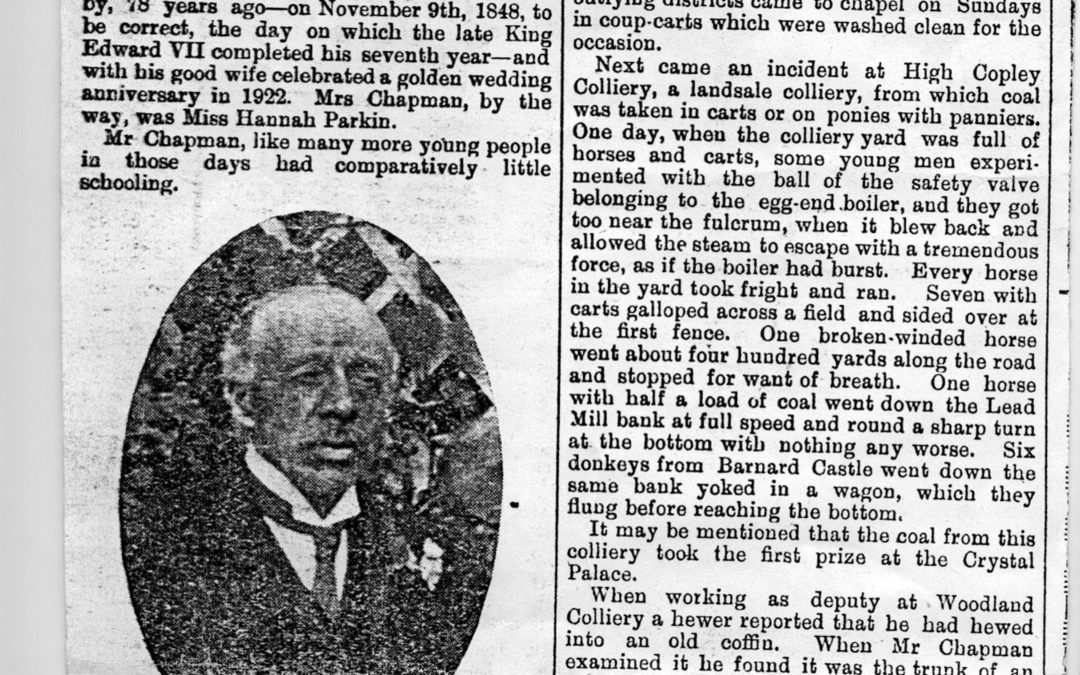
Mr. Chapman, like many more young people in those days had comparatively little schooling. “I started work when I was about nine years old”, he said, “leading coals from Mr. John Hardy’s Crake Scarr Colliery to Mr. Steel’s tan pits, at Barnard Castle. The tan pits were on the ground now occupied by the Victoria hall. The cos of coal was one penny per hundredweight for small, and 2½d. and 8d. for screened best. I next started to work at the Gaunless Lead Mill, near Copley, at four shillings per week, the hours being 7 a.m. to 5 p.m. This mill has now all been removed except the chimney, the blacksmith’s shop, the Master’s house and the mess-room. The chimney, which is still in good condition, was built in 1832 by Charles Wharton, of Woodland, who died May 14th, 1860, aged 60. The chimney can be seen for miles round. The mill ceased to work in November, 1879. The lead ore was brought by ‘jagger’ ponies from the Shineberry, Wiregill and other lead mines west of this place, and the hardy little animals returned laden with coal for the Egglestone district. The brick and tile machinery was driven by a large water wheel. A large number of men were engaged at this mill, the products being lead, silver, bricks, tiles and letharge, which was put into barrels and sent to London to make paint.
“I next went to work for John Hardy, picking stone from the coal at five shillings per week; then to drive a pit pony at 1s. 2d. per day, and next to drive and “hang on” at 1s. 4d. per day. To “hang on” means to hang the corves, which were full of coals, on to the rope at the shaft bottom and remove the empty ones which were returned. These corves resembled large hampers or baskets made of willow”.
“I later returned to the Lead Mill for four-and-a-half-years, supplying the furnaces with coal, and subsequently started joiner-work at Cow Close Colliery, which then belonged to Messrs. Ord & Maddison. From there I went to Butterknowle Colliery to hew coals in a seam 1’ 8” high, and thence to new Copley Colliery to sink a shaft. I worked as a journeyman joiner for Mr. T. Wilkinson, of Copley. After this I went to Woodland Colliery as Deputy, then to High Copley Colliery as manager for Mr. W. Teasdale, being later a manager for Messrs. S. Walker and M. Bradley at Seven Sisters’ Colliery.”
“After this I started a joinery business on my own account. The machinery, consisting of a band-saw, circular-saw, lathe and grindstone, was driven by a windmill. I have farmed a small parcel of land, which formerly belonged to the late Duke of Cleveland, who was followed by the late and present Lord Barnard. The land has been in my family’s occupation for over 170 years and now belongs to a son-in-law. I put up all the buildings on this land except one small cow-house, and built on it the first hay-shed in the district, which stands good to this day, not far away from the Gaunless Lead Mill”.
From this story of his own long life Mr. Chapman turned to some of the many incidents which he remembers to have taken place during the latter half of the last century and the first quarter of this.
“When I was a boy there used to be meetings called “Tom Trott joins”, gatherings of friends at someone’s house where they spent an enjoyable evening by making, in a large pan, “Tom Trott”, or home-made toffee, which, when cooled was handed round for the guests to eat. While one of these ‘joins’ was in progress and the guests were sitting round the fire, a friend and I caught a fowl and dropped it down the chimney. The result can be better imagined than described”.
Mr. Chapman was one of the first in the district to practice photography, while it was still in the wet-plate process. No prepared plates or sensitised paper were procurable then. A tent had to be part of one’s accessories.
Recent Comments